
Author vs Interpreter
Due to a rather funny recent encounter

It is valid for readers to try to look for implicit meaning and themes in books.
It is not valid for a reader to claim author-ity over what a book's message is.
Example: LotR was not an allegory about the atomic bomb. Tolkien adamantly disagreed with that reader theory. And he was correct, because it is his book.
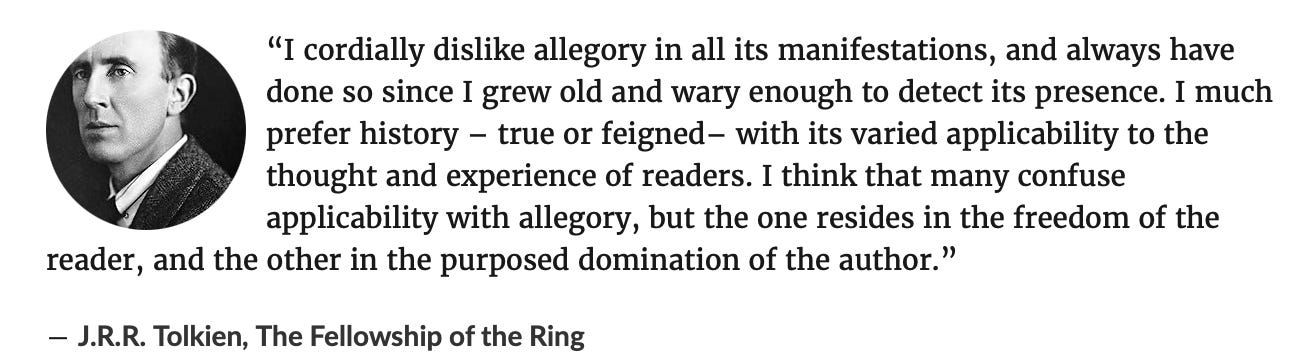
Just because readers drew a parallel, does not mean that the book is an allegory about the atomic bomb.
A reader can find parallels, patterns, and other such things in a book, but you can also see human faces in planks of wood. Not every connection you draw is more than coincidence. Not everyone comes to the same conclusions while looking at the same set of evidence.
Ultimately, the author of the book is the one who decides what their book is about, what the theme is, what the morals are etc.
I carved a wine cork recently. If someone decided that because it is the same color as a cookie, then it must be a cookie, that does not make the wine cork a cookie. I made it. I know it is not a cookie. It is a wine cork. If I sell it to that person, they are free to eat it if they want, but that doesn’t make it a cookie just because they’re saying it’s a cookie due to parallels about color and size.
Author and authority share common etymological origins, because the one who creates the thing is the one who forms it into what it is, knows what it is, has chosen every word, and thus has the authority to say what it is.
So if I say the book I wrote has no political message or political leaning, that means that it does not.
If a reader says that it does, that means that they have added an extra layer of interpretation on top of the book that does not actually exist in the book. They have gotten a message or a meaning out of it that is derived from how their personal worldview reacts with the actual content of a book.
This is like mixing bleach and vinegar. You get chlorine gas. That does not mean that vinegar is chlorine gas—vinegar actually has no chlorine in it whatsoever. If you mix vinegar with baking soda, you get some carbon dioxide.
This is how different readers get completely different experiences out of books. Authors hand their readers vinegar, and readers' differing worldviews react with the content to produce an interpretation and experience of the book.
This is good, this is a part of reading, a part of writing. And I've found it incredibly fascinating to see how many different reactions there've been to my writing.
But ultimately, if you are arguing with an author on what their book is about, you are incorrect.
"Death of the author" does not mean "the author has no authority to say what their book is about once it's in the hands of readers," it means that each reader can find their own personal meaning from books. They are not obligated to read the book the way the author intends for them to read it. They are free to ignore the author's intended messaging and find their own. But this is interpretation not authoritative truth about the content.
If your worldview is so hyperfocused on politics that you are looking for it in every book, then you will find it. You are reading through the lens of your own worldview, and the glass in that lens is cracked. The crack that you see is a distortion in your own interpretive lens that alters how you perceive the content that you read.
I would also like to note that it is rather insulting to try and claim that you know better than the author what their book's message is.
Perhaps the author in question does have a message, a message you have missed completely because the crack in your lens obscured it.
Perhaps their series is, in part, an elegy to their lost father. Perhaps it is a story about profound regret and redemption; struggling with morality; trying to balance love, loyalty, family, and sense of self.
Perhaps it is about how a person can feel like she has no identity, that she is simultaneously no one and anyone. Erasable. Rewritable.
And when you claim that such an issue is political, you have failed to actually see the story.
I make a lot of jokes about my book, because truly, it is absurd. That absurdity doesn't make it meaningless.
I wrote an entire world to express things that I could never begin to express outside of fiction. None of it has anything to do with the petty politics of this world, and that was intentional, because I wanted to take these issues out of this world, isolate them, and illustrate them more clearly.
Take whatever meaning you find in a book, but understand that sometimes your worldview is producing an interpretation that is not actually valid.
I will leave you with a lovely quote from Mark Twain about his Adventures of Huckleberry Finn:
“Persons attempting to find a motive in this narrative will be prosecuted; persons attempting to find a moral in it will be banished; persons attempting to find a plot in it will be shot.
BY ORDER OF THE AUTHOR
per
G.G., CHIEF OF ORDNANCE”